
Golf course maintenance is the daily, year-round work of mowing, watering, feeding and repairing the turf so the ball rolls true and the course stays healthy. On a typical summer morning the crew is out before sunrise: mowing greens, cutting new holes, raking bunkers and moving tee markers, all before the first group tees off. Then come the bigger jobs you only notice now and then, like aeration, topdressing and frost delays.
This guide walks you through what the maintenance crew really does, how short the grass is cut, why your favorite greens suddenly have holes in them, what it costs to keep 18 holes in shape, and the small things you can do as a golfer to help. Next time you see a “cart path only” sign, you’ll know exactly why it’s there.
⛳ Quick Answer: What Golf Course Maintenance Includes
- Every day: mow greens, change hole locations, rake bunkers, move tee markers, check irrigation
- Every week: mow tees, fairways and rough, fix divots, spray or spoon-feed fertilizer as needed
- A few times a year: core aeration, sand topdressing, overseeding, bunker sand top-ups
- Who runs it: a golf course superintendent and a crew of roughly 12 to 25 people
- What it costs: about $557,000 to $1.08 million a year for an 18-hole course, depending on type
In this guide
- Why golf course maintenance matters
- A day on the maintenance crew
- 10 main golf course maintenance tasks
- Mowing heights: how short is the grass?
- Why courses aerate perfect greens
- Frost delays explained
- The maintenance year, season by season
- What golf course maintenance costs
- How golfers can help (and mistakes to avoid)
- FAQ
Why Golf Course Maintenance Matters
Good golf course maintenance makes the game fair, safe and fun. Healthy, evenly cut turf lets a putt roll on its line, gives you a clean lie in the fairway and keeps bunkers playable after a storm. A course is basically a huge living lawn that thousands of golfers walk on, drive carts over and take divots out of every month. Without steady care, it would turn patchy, bumpy and brown within weeks.
Think about the last time you played a course that had been neglected. Greens that bounced your putts offline. Bunkers with hard, crusty sand. Fairways with bare spots right where good drives land. That’s what happens when the budget or the crew gets cut, and it’s why superintendents plan their work so carefully.

So who does all this work, and when? Let’s follow a crew through a normal summer morning.
A Day on the Golf Course Maintenance Crew
Most of the daily maintenance happens before you arrive. The crew starts early so mowers stay ahead of the first tee times, and the timing is tight. Here’s what a typical in-season morning looks like at many courses (exact times vary by course and daylight):
- Before sunrise: the superintendent checks the weather, the overnight irrigation run and the day’s schedule, then hands out jobs.
- First light: greens mowers head out ahead of the first group. Another crew member cuts new holes and moves the cups.
- Next: bunkers get raked, tee markers get moved to fresh grass, and divot bottles or sand buckets get refilled.
- Mid-morning: fairway, tee and rough mowing work around the groups on the course.
- Afternoon: hand watering of dry spots, spraying, repairs, and mower cleaning and sharpening back at the shop.
- Night: the computer-controlled irrigation system runs, when there’s less wind and less water lost to evaporation.
The person running all of it is the golf course superintendent. They plan the work, manage the crew, order fertilizer and sand, and write the budget for machinery, staff, fuel and chemicals. Many hold the CGCS (Certified Golf Course Superintendent) credential through the Golf Course Superintendents Association of America (GCSAA).
10 Main Golf Course Maintenance Tasks
Now that you know the daily rhythm, here are the ten jobs that keep a course in shape. Some happen every morning; others happen only a few times a year but make a huge difference.
1. Mowing greens, tees, fairways and rough
Mowing is the most basic and most important part of golf course maintenance. Greens are cut the shortest and most often, usually every day in the growing season, with precise reel mowers. Fairways and tees get cut a few times a week, and rough about once a week, depending on how fast the grass grows. Sharp blades matter: a dull mower tears the grass tip, which turns it brown and invites disease. Many courses also roll greens with a heavy roller to make them smoother and faster without cutting lower.
2. Watering and irrigation
Modern courses run computer-controlled sprinkler systems that water at night or early morning, when less water evaporates. The goal is to water deeply but not too often, so roots grow down. Crews also hand-water dry spots during the day, which is why you sometimes see someone with a hose on a green in July. Courses have gotten much better at this. A 2025 GCSAA water survey found US courses applied about 1.63 million acre-feet of water in 2024, 31% less than in 2005, and recycled water was 19% of irrigation sources.
3. Fertilizing (feeding the grass)
Grass that’s cut this short and played on this much needs regular feeding. Greens often get light, frequent doses during the growing season (sometimes as liquid “spoon-feeding”), while fairways and rough get fertilized a few times a year. Superintendents follow soil tests and local rules so nutrients stay in the turf instead of washing into ponds and streams.
4. Aeration and topdressing
Aeration pulls small cores of soil out of the green to relieve compaction, control thatch and let air and water reach the roots. It’s usually followed by topdressing, a thin layer of sand brushed into the holes. It’s the job golfers complain about most, so it gets its own section below.
5. Pest, disease and weed control
Crews scout every day for fungus, insect damage (grubs love the roots under fairways) and weeds. Most courses use integrated pest management: they fix the cause first (shade, drainage, too much water), then treat only where needed, often early in the morning or late in the day when no one is around. Pre-emergent weed control usually goes down in spring before crabgrass sprouts.
6. Bunker maintenance
Bunkers get raked most mornings to erase footprints and loosen the sand. Crews also edge the grass lips, pull weeds, top up sand when it gets thin and fix washouts after heavy rain, when sand slides down the faces. Drainage pipes under bunkers need checking too, or a bunker can sit full of water for days.
7. Divot and ball mark repair
Every round leaves damage: divots on tees and fairways, ball marks on greens. Crews fill divots with a sand-and-seed mix and fix missed ball marks. This is where golfers make the biggest difference. A ball mark you fix right away heals quickly; one left alone can scar the green for weeks.
8. Tee boxes and course setup
Tee markers move every day or so to spread out wear, and hole locations on greens change often for the same reason. Setup also means putting out flags, rakes and ball washers, keeping hazard and out-of-bounds stakes painted and in place, and making sure signs and cart paths are in good shape.
9. Equipment maintenance
Behind every perfect green is a shop full of mowers. An equipment manager (often called the “equipment tech”) sharpens reels, changes oil, checks tire pressure so heavy machines don’t rut the turf, and keeps the fleet of golf carts charged and running. If you own a cart, the same habits apply. Our guides to golf cart battery costs and the difference between 48V and 51.2V golf cart batteries explain the battery side.
10. Seasonal and environmental work
Some work only happens at certain times of year: overseeding, tree trimming, drainage projects, bunker renovations and winter prep. Many courses also manage native areas, ponds and wildlife habitat. If you’re curious about that side, read our piece on how golf courses affect local ecosystems.
| Task | How often (in season) | Why it matters to you |
|---|---|---|
| 🟢 Mow greens | Daily | True, consistent putting speed |
| 🕳️ Change hole locations | Daily or every few days | Spreads wear, fresh challenge |
| 🏖️ Rake bunkers | Most mornings | Fair lies in the sand |
| 🚩 Move tee markers | Daily or as needed | Level, healthy teeing ground |
| 💧 Irrigation | Nightly, plus hand watering | No dry, crusty spots |
| ⛳ Mow fairways and tees | 2 to 3 times a week | Clean lies, ball sits up |
| 🌾 Mow rough | About weekly | Playable, findable balls |
| 🌱 Fertilize | Greens often, fairways a few times a year | Thick, quick-healing turf |
| 🔩 Aerate and topdress | 1 to 2 times a year (course specific) | Firm greens, deep roots |
| 🔧 Equipment service | Daily cleaning, scheduled service | Clean cuts, no breakdowns |
Frequencies are typical ranges. Every course adjusts for its grass type, climate and budget.
Golf Course Mowing Heights: How Short Is the Grass?
Putting greens are usually mowed to about one-eighth of an inch, and anywhere from about 1/10 to 3/16 inch depending on the grass and the season. That’s shorter than the thickness of two stacked quarters. Tees and fairways sit around 1/4 to 3/4 inch, according to University of Nebraska–Lincoln turf extension guidance, and rough is often kept around 1.5 inches, sometimes 2 inches or more in peak season.
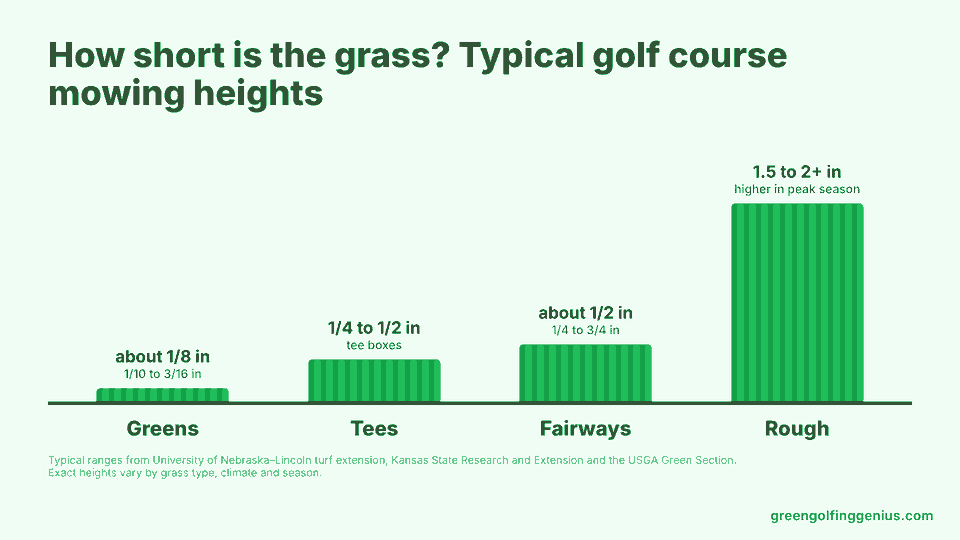
Here’s the catch: those numbers move during the year. The USGA Green Section describes Florida courses keeping fairways near 0.5 inch most of the year, dropping lower in summer and raising them up to about 0.7 inch in the busy season, with rough moving between about 1 and 2 inches. Superintendents also raise heights during heat and drought stress, because taller grass copes better. That’s why the same green can feel quick in June and slower in August.
Turf managers follow the “one-third rule” as a guide: don’t remove more than a third of the leaf in one mowing. On a green cut at 1/8 inch, that means mowing every day when it’s growing fast. Skip a few days and you’d have to scalp it.
Why Do Golf Courses Aerate Greens When They’re Perfect?
Courses aerate greens to remove built-up thatch and organic matter, relieve soil compaction from foot traffic, and help water and air reach the roots. They do it when the greens look great because healthy, actively growing grass heals fastest. The USGA explains that too much organic matter “acts like a sponge,” holding water near the surface and leading to soft, bumpy, disease-prone greens.
Picture this: you book a Saturday round in early September, and when you get to the first green it’s covered in neat rows of holes and sand. Frustrating? Sure. But that same green will be firmer, smoother and healthier next summer because of it. The USGA’s aeration Q&A calls a week or two of bumpy putting “a fair trade,” and notes that recovery depends on grass type, hole size, turf health and weather.
How often? It’s course specific. Many courses core-aerate greens once or twice a year, often spring and late summer or fall, and may add smaller “venting” treatments with tiny solid tines in between that barely affect play.
Frost Delays: Why You Can’t Tee Off Yet
A frost delay happens because walking or driving on frozen grass breaks the ice crystals inside the grass blades, which ruptures the plant cells. According to the USGA, the damage doesn’t show right away. It appears days later as brown footprints and tire tracks, and if the growing point of the plant is hurt, recovery can take months.
That’s a big deal on greens, because a foursome takes several hundred footsteps on each one. So the course waits until the frost has fully melted. Shaded greens, north-facing holes and low spots where cold air settles stay frosty longest, so the course may open the sunny holes first. If it’s a cold morning, call the pro shop before you leave home.
The Golf Course Maintenance Year, Season by Season
Golf course maintenance follows the calendar. The exact schedule depends on whether the course has cool-season grass (like bentgrass, common in the North) or warm-season grass (like bermudagrass, common in the South), but the pattern looks like this:
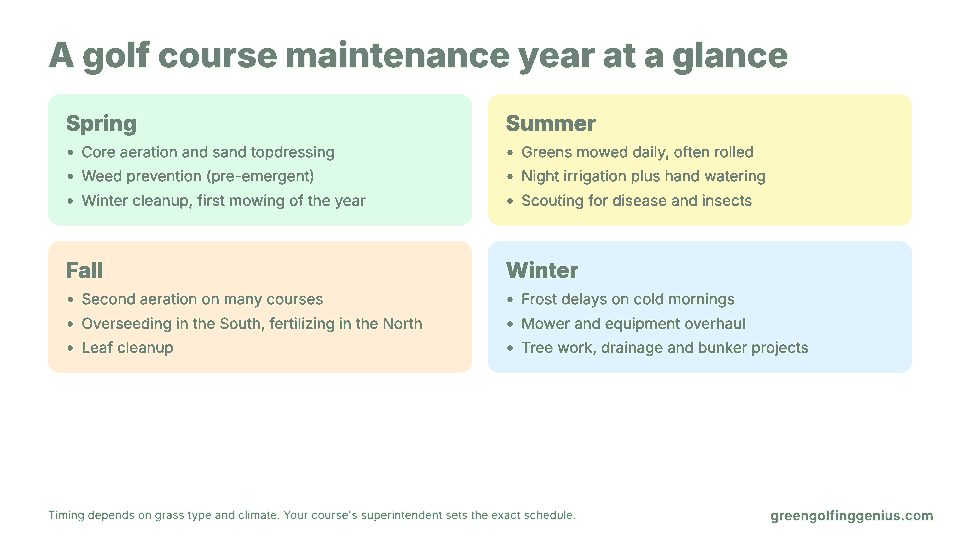
- Spring: cleanup from winter, first mowings, core aeration and topdressing, and pre-emergent weed control.
- Summer: daily greens mowing and rolling, careful irrigation, hand watering, raised heights during heat stress, and constant disease scouting.
- Fall: a second aeration on many courses, overseeding warm-season courses with ryegrass in the South, fertilizing and leaf cleanup in the North.
- Winter: frost delays, blowing out irrigation lines in cold climates, covers on some greens, plus mower overhauls, tree work and drainage or bunker projects.
Winter golfer? Our guide on playing golf in any weather covers how cold, wet and windy conditions change your game.
How Much Does Golf Course Maintenance Cost?
Maintaining an 18-hole golf course costs roughly $557,000 to $1.08 million a year, depending on the type of course. Using GCSAA data, GOLF.com reported an overall average of $810,254, with private clubs spending the most and daily-fee courses the least. Labor is the biggest single cost, about 56.7% of the budget.
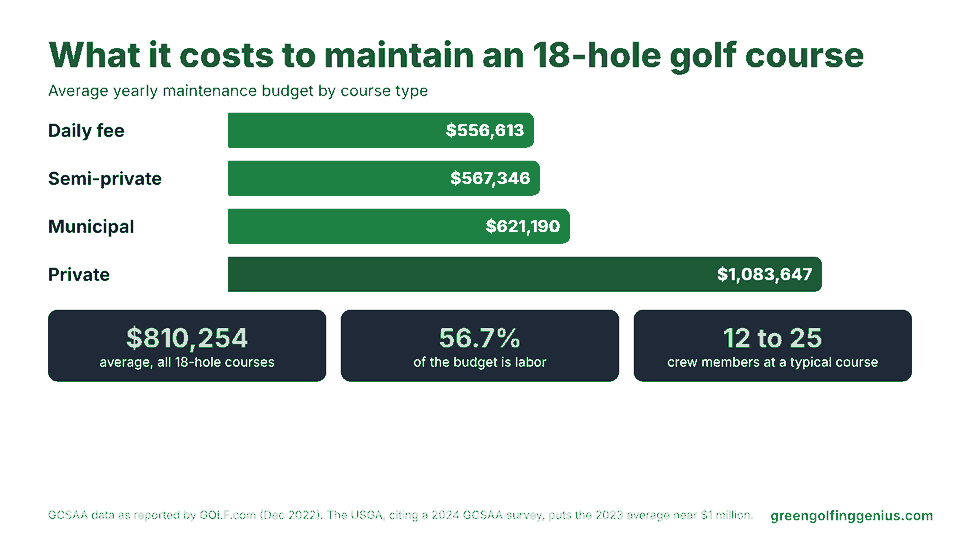
| Course type | Average yearly maintenance budget | Of which labor |
|---|---|---|
| Daily fee | $556,613 | $294,456 |
| Semi-private | $567,346 | $312,476 |
| Municipal | $621,190 | $349,839 |
| Private | $1,083,647 | $630,104 |
| All 18-hole courses | $810,254 | $463,163 |
GCSAA figures as reported by GOLF.com (December 2022). Costs have risen since; the USGA, citing a 2024 GCSAA survey, puts the 2023 average near $1 million.
Those numbers are climbing. A USGA Green Section article citing a 2024 GCSAA survey says the average 18-hole course spent nearly $1 million on maintenance in 2023, about 23% of facility revenue. Equipment is pricey too: GOLF.com lists a rough mower at about $100,000 and a fairway mower near $80,000, which is why many courses lease their daily machines.
Here’s why that matters to you. When green fees go up or a course switches to “cart path only” more often, it’s usually tied to these costs and to protecting the turf. Curious how all this shows up in your own spending? See what golf really costs per year. And if you’ve ever wondered how much land all this covers, read how many acres a golf course needs.
How Golfers Can Help (and Mistakes to Avoid)
You can’t mow the greens, but you can make the crew’s job a lot easier. Most damage on a busy course comes from small habits repeated by hundreds of players a week. Here are the most common mistakes, and the easy fix for each:
- Not fixing ball marks. Push the edges in toward the center with your repair tool, don’t lift the middle, then tap it flat with your putter. Fix yours plus one more.
- Leaving divots open. Replace the turf if it’s in one piece, or fill the hole with the sand-and-seed mix on your cart, then smooth it with your foot.
- Skipping the rake. Enter and leave bunkers from the low side and rake your footprints and the area you hit from.
- Ignoring cart signs. “Cart path only” and the 90-degree rule protect wet or stressed turf from ruts. Never drive near greens or tees.
- Dragging feet or standing in the hole area. Pick up your feet on greens and keep the flagstick and your putter off the surface around the cup.
- Getting annoyed at the crew. If a mower is on the green, wait. They have one job before your group catches up, and the course is better for it.
✅ Course-Care Checklist for Every Round
- ☐ Ball mark repair tool in my pocket
- ☐ Fix my ball mark plus one more on each green
- ☐ Replace or fill every divot
- ☐ Rake bunkers after I play out
- ☐ Follow cart signs and stay off wet areas
- ☐ Wait for the crew to finish before hitting
New to the game? Our basic golf rules guide covers the etiquette side, and knowing how long 18 holes should take helps you keep pace while still caring for the course.
Frequently Asked Questions
What does golf course maintenance include?
It includes mowing greens, tees, fairways and rough, irrigation, fertilizing, aeration and topdressing, pest and weed control, bunker raking, divot and ball mark repair, moving holes and tee markers, and servicing the mowers and carts.
How often are golf greens mowed?
Usually every day during the growing season, sometimes followed by rolling. In slow-growth periods, some courses mow every other day and roll in between.
How much does it cost to maintain a golf course?
About $557,000 to $1.08 million a year for 18 holes, with an average of $810,254 in GCSAA data reported by GOLF.com. A 2024 GCSAA survey cited by the USGA puts the 2023 average near $1 million.
Why do golf courses punch holes in the greens?
That’s core aeration. It removes thatch and organic matter, relieves compaction and helps water and air reach the roots, so greens stay firm and healthy. Most recover in one to two weeks.
Why are there frost delays in golf?
Walking or driving on frozen grass ruptures the plant cells. The damage shows up days later as brown footprints and can take months to recover, so courses wait until the frost melts.
What does a golf course superintendent do?
The superintendent runs golf course maintenance: planning daily jobs, managing the crew, making agronomy decisions on water, fertilizer and pest control, and building the yearly budget.
The Bottom Line
Golf course maintenance is a mix of daily routine and long-term planning: mowing and moving holes every morning, feeding and watering with care, and accepting a little short-term pain like aeration or frost delays for healthier turf all season. It costs most 18-hole courses well over half a million dollars a year, and labor is the biggest piece.
Your part is simple. Fix your ball marks, fill your divots, rake the bunkers and respect the cart signs. Do that, and the course you love will play better for you and everyone behind you. And next time you see the crew at sunrise, give them a thank-you. They earned it.
Keep learning: more from Green Golfing Genius
- Golf courses and local ecosystems
- How many acres do you need for a golf course?
- What golf really costs per year
Sources: USGA Green Section (frost delays, aeration, mowing heights, maintenance costs); GCSAA water survey via Golf Business News (Dec 2025); GOLF.com and GCSAA budget data (Dec 2022); University of Nebraska–Lincoln turfgrass extension (2023); GCSAA. Last reviewed November 19, 2026.
Have you ever played a course right after aeration? Tell us how it putted in the comments.