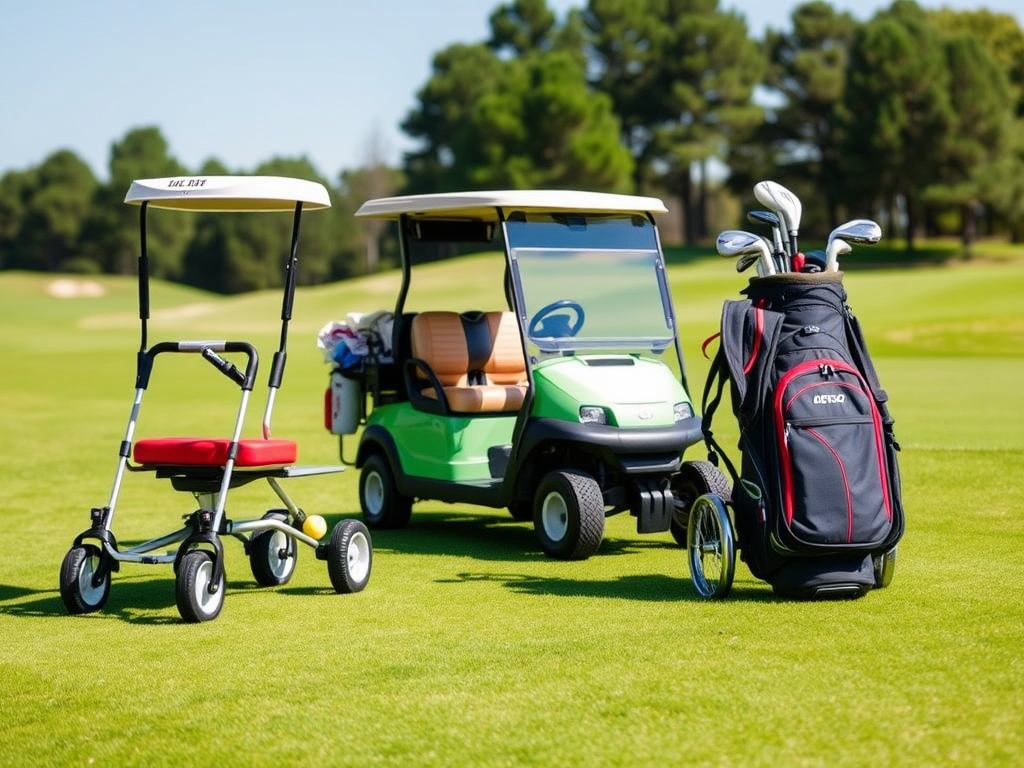
Push cart, riding cart, or carry bag? Real calorie data, scoring research, and cost math to help you choose how to get around the course
Golf Push Cart vs Golf Cart vs Carry Bag: An Honest, Data-Backed Comparison
How you move your clubs around eighteen holes is one of the few equipment decisions in golf that measurably affects three things at once: your health, your score, and your wallet. It is also one of the least examined. Most golfers default to whatever they started with — a carry bag from their beginner set, or a riding cart because that is what the course rents.
The research on this is better than you would expect. Exercise physiologists have put golfers in VO2 masks and measured energy expenditure across all three modes. Golf associations have tracked scoring differences. And the results are not entirely what the marketing on either side would have you believe.
This comparison covers what the studies actually found, where each option genuinely wins, the real cost math over one season and five seasons, and — importantly — the honest downsides of each. No option here is universally best, and anyone telling you otherwise is selling something.
The Short Version
| If you… | Choose | Why |
| Want maximum exercise with minimum joint strain | Push cart | Nearly the same calorie burn as carrying, without the shoulder and back load |
| Play fast, carry little, walk short courses | Carry bag | Lightest option, no equipment to store or transport, cheapest by far |
| Have mobility limitations, play in extreme heat, or need pace-of-play speed | Riding cart | Removes the physical barrier entirely; some courses mandate it |
| Play 36 holes in a day or are recovering from injury | Riding cart or electric push cart | Fatigue management matters more than calorie burn over long days |
What the Research Actually Found
The most frequently cited study on this question was conducted by the Colorado Golf Association in partnership with exercise physiologist Neil Wolkodoff. Ten golfers each played three separate nine-hole rounds — one with a push cart, one with an electric push cart, and one riding — while wearing VO2 measurement equipment.
Calorie Burn by Transport Mode
A separate frequently cited data set from the Rose Center for Health and Sports Sciences measured calorie expenditure across nine holes:
| Method | Calories (9 holes) | Relative to Riding |
| Carrying your own clubs | 721 | +75% |
| Push cart | 718 | +75% |
| Walking with a caddie | 613 | +49% |
| Riding in a motorized cart | 411 | baseline |
| The finding that surprises most golfers Push cart: 718 calories. Carrying: 721 calories. That is a difference of three calories over nine holes — statistically meaningless. You get essentially the entire fitness benefit of carrying your bag while removing 15 to 30 pounds from your shoulders and back. | ||
Other framings of the same underlying research put it differently: golfers walking with a push cart burn roughly 36 percent more calories per hour than those riding, with the gap widening over a full eighteen holes. Golf Digest’s coverage of the Wolkodoff study reported walkers burning almost 80 more calories per hour than riders.
A Necessary Caveat on the Numbers
Published calorie figures for golf vary enormously depending on methodology. A peer-reviewed review noted estimates for activity energy expenditure ranging from 531 to 2,467 kilocalories per eighteen holes — a nearly fivefold spread — attributed largely to differences in how researchers measured it.
More conservative, ecologically valid measurements from Kasper et al. reported activity energy expenditure of roughly 650 to 750 kcal per eighteen-hole round, with no significant differences between carrying, push trolley, and electric trolley. That study did not include a riding group because it was conducted during a period when cart use was not permitted.
The honest summary: walking clearly burns more than riding, and push cart is essentially equivalent to carrying. The precise numbers should be treated as directional rather than exact.
The Scoring Data: Does Walking Actually Help Your Game?
This is where the Wolkodoff study produced its most interesting finding. Over nine holes, scores relative to par broke down as follows:
| Transport Mode | Score Over Par (9 holes) | Self-Reported Mental Focus (of 10) |
| Push cart | 10.4 | Higher than riding |
| Electric push cart | 10.2 | 6.63 |
| Riding cart | 11.5 | 5.01 |
Walkers finished roughly 1.1 to 1.3 strokes better over nine holes than riders, and rated their mental focus meaningfully higher. Wolkodoff’s own explanation was about decision-making rhythm: walking gives you time to think about the shot, rehearse it, and arrive at the ball prepared. In a cart you are holding on, then abruptly out and hitting.
Where This Finding Needs Qualification
A more recent peer-reviewed study on tournament golf raised the counterpoint honestly: cognitive benefits from walking may be offset by accumulated physical fatigue over eighteen holes or in demanding conditions. Fatigue has been separately linked to reduced shot consistency. Because lower activity energy expenditure means less physical fatigue, riding may help maintain physical readiness on long or hot rounds.
The researchers’ own conclusion was that further research is warranted on the trade-off between cognitive and physical fatigue across transport modes. Anyone presenting the scoring benefit of walking as settled science is overstating it — the nine-hole finding is real, but the eighteen-hole and tournament picture is genuinely more complicated.
Option 1: The Carry Bag
How It Works
A stand bag with dual shoulder straps, typically weighing 4 to 6 pounds empty and 20 to 30 pounds fully loaded with fourteen clubs, balls, water, and accessories.
Where It Genuinely Wins
Cost is the obvious one — you need a bag regardless, so this option adds nothing. Speed is the second: no equipment to unfold, maneuver around bunkers, or navigate through narrow gaps. On tight, walkable municipal courses, a carrying golfer often moves faster than a push cart golfer.
Storage and transport also matter more than people expect. A carry bag fits in any trunk. A push cart takes up meaningful space, and folding and unfolding it every round becomes a small tax on your time.
The Honest Downsides
Twenty to thirty pounds across your shoulders for four to five miles has real consequences. The load compresses the spine, fatigues the shoulders and trapezius, and — for golfers with existing back, shoulder, or knee issues — can turn a pleasant round into an aggravating one.
There is also a swing consequence that gets underdiscussed: carrying a heavy bag through the back nine fatigues the same muscle groups your swing depends on. The calorie data shows carrying and push cart are equivalent in energy expenditure, which means the extra shoulder load buys you nothing in fitness terms while costing you in fatigue.
Best for: Golfers under 40 with no back or shoulder issues, playing flat and walkable courses, prioritizing speed and simplicity
Option 2: The Push Cart
How It Works
A three-wheel or four-wheel frame that holds your bag and rolls ahead of you. Three-wheel models steer more easily and are the most common; four-wheel models track straighter and are more stable on slopes. Electric versions add a motor that either follows you or is remote-controlled.
Where It Genuinely Wins
The core case is the calorie data: 718 versus 721 calories means you retain essentially all of the fitness benefit of walking while transferring 20 to 30 pounds off your body. For anyone over 45, anyone with joint issues, or anyone who wants to play more frequently without accumulating wear, this is a meaningful trade.
Secondary benefits that add up: your scorecard, rangefinder, drinks, and rain gear are all at waist height rather than requiring you to set the bag down and bend over. On rainy days, an umbrella mounts to the cart rather than requiring a free hand.
There is also a documented curiosity worth noting for honesty’s sake: MyGolfSpy’s review of the underlying MET-score research found that pulling a cart was reported as requiring more effort than carrying, with previous research showing higher heart rates when pulling than carrying. This applies to older pull-style carts rather than modern push designs, but it is a reminder that the ergonomics of cart design matter.
The Honest Downsides
Cost is real: quality push carts run $150 to $300, and electric models run $600 to $2,500. Storage is real: a folded push cart occupies significant trunk space permanently. Terrain is real: on steep, hilly courses, pushing a loaded cart uphill is genuinely harder than carrying, and on courses with heavy cart-path-only restrictions or narrow bridges, a cart becomes an obstacle.
Some courses also restrict push carts on certain greens complexes or during wet conditions, which is worth checking before buying.
Best for: Golfers who walk regularly, play 18 holes frequently, are over 40, or have any shoulder, back, or knee concern
Option 3: The Riding Cart
How It Works
Motorized cart, typically rented from the course at $15 to $25 per player per round, or included in cart-fee-inclusive green fees.
Where It Genuinely Wins
The dismissive framing of riding carts as pure laziness does not survive contact with the data. A 180-pound golfer riding eighteen holes still burns roughly 800 to 1,200 calories, still walks two to three miles from cart to ball and around greens, and still accumulates 5,000 to 8,000 steps. That is meaningful activity by any reasonable standard.
More importantly, riding carts make golf accessible to people who otherwise could not play: golfers with mobility limitations, cardiac conditions, arthritis, or recovering from surgery. Framing riding as a moral failure ignores that for a substantial number of players it is the difference between playing and not playing.
Heat is a legitimate factor too. On a 95-degree day in Georgia or Arizona, walking eighteen holes carries real heat-illness risk that riding substantially reduces.
And there is a fatigue argument supported by the research: because riding produces lower activity energy expenditure, it may help maintain physical readiness across thirty-six-hole days or demanding tournament conditions.
The Honest Downsides
Cost accumulates faster than anything else on this list. At $18 per round, a golfer playing weekly spends $936 per year on cart fees alone — more than three premium push carts, every single year.
The fitness gap is real: 411 versus 718 calories over nine holes is not a rounding error. And the nine-hole scoring data showed riders finishing over a stroke worse with measurably lower self-reported focus.
Best for: Golfers with mobility or health limitations, extreme-heat conditions, courses that mandate carts, thirty-six-hole days, and anyone who simply prefers it
The Full Comparison Table
| Factor | Carry Bag | Push Cart | Riding Cart |
| Calories (9 holes) | 721 | 718 | 411 |
| Physical load on body | High — 20-30 lbs on shoulders | Low — weight on wheels | Minimal |
| Upfront cost | $0 (bag already owned) | $150-$300 manual; $600-$2,500 electric | $0 |
| Cost per round | $0 | $0 after purchase | $15-$25 |
| 5-year cost (weekly play) | $0 | $150-$300 | $3,900-$6,500 |
| Speed of play | Fastest on tight courses | Moderate | Fastest on long, spread-out courses |
| Hilly terrain | Hard | Hardest (pushing uphill) | Easiest |
| Storage / transport | Trivial | Takes permanent trunk space | None |
| Accessibility of gear mid-round | Poor — must set bag down | Excellent — waist height | Excellent |
| Best documented focus score | — | Higher than riding | 5.01 / 10 |
The Five-Year Cost Math
This is the calculation most golfers never run, and it is the strongest financial argument in the comparison.
| Scenario | Year 1 | Year 3 | Year 5 |
| Carry bag only | $0 | $0 | $0 |
| Manual push cart ($220) | $220 | $220 | $220 |
| Electric push cart ($900) | $900 | $900 | $900 |
| Riding cart, weekly play @ $18 | $936 | $2,808 | $4,680 |
A $220 push cart breaks even against riding fees in roughly twelve rounds. Even a $900 electric push cart pays for itself inside a single season of weekly golf. If cost is a meaningful factor for you and you are physically able to walk, the math is not close.
The caveat that keeps this honest: many courses bundle the cart fee into the green fee whether you use it or not, particularly at resort and private courses. In that case walking saves you nothing financially, and the case for walking rests entirely on the health and focus arguments.
The Case Nobody Makes: Owning More Than One
These options are not mutually exclusive, and treating them as a permanent identity choice is the most common mistake golfers make here.
A reasonable setup for a frequent golfer: a lightweight carry bag for quick nine-hole evening rounds and tight walkable courses, plus a push cart for full eighteen-hole rounds. Total additional cost is one push cart. The two cover genuinely different situations, and switching based on the round rather than habit produces better outcomes than committing to one.
Similarly, riding on the hottest three weeks of summer and walking the rest of the year is not inconsistency — it is sensible adaptation to conditions.
The Broader Health Context
Worth keeping the whole thing in perspective: a large Swedish study tracking over 300,000 golfers for more than twenty years found a 40 percent lower mortality rate among golfers compared to non-golfers. The benefits were attributed to consistent low-to-moderate activity, time outdoors, social connection, and mental engagement.
That finding did not separate walkers from riders. Which means the single most important variable is not how you get around the course — it is whether you are on the course at all. A golfer who rides fifty rounds a year is getting substantially more health benefit than a golfer who walks five.
| The honest bottom line Walking with a push cart is measurably better for calorie burn, and modestly better for focus and nine-hole scoring. But the difference between playing golf and not playing golf dwarfs the difference between any of these three options. Choose the one that gets you out most often. |
Conclusion
The data supports the push cart as the best default for most physically able golfers: it delivers essentially identical calorie burn to carrying (718 vs 721 over nine holes) while removing 20 to 30 pounds from your body, and it pays for itself against cart fees inside a dozen rounds.
But the honest version of this comparison has to include the parts that cut the other way. The scoring benefit of walking is documented at nine holes and genuinely uncertain at eighteen under fatigue. Riding carts still produce 800 to 1,200 calories of activity over a round and make golf possible for players who otherwise could not play. And on steep terrain or in dangerous heat, walking is the worse choice on any reasonable analysis.
Match the method to the round, the course, the weather, and your body on that particular day. That is a less satisfying conclusion than a verdict, but it is what the evidence actually supports.
For more golf equipment comparisons, course guides, and game improvement content, visit Green Golfing Genius. If you are shopping for a bag to pair with a push cart, our walking golf bags guide covers the models that fit cart frames best. [Internal link: link to your walking golf bags article and golf statistics article]
Frequently Asked Questions
Do you burn more calories carrying your bag or using a push cart?
Essentially the same. Research from the Rose Center for Health and Sports Sciences measured 721 calories over nine holes when carrying versus 718 with a push cart — a three-calorie difference. You get the same energy expenditure with a push cart while removing 20 to 30 pounds from your shoulders.
Does walking actually lower your golf score?
The nine-hole evidence says modestly yes. In the Wolkodoff study, push cart users finished 10.4 over par and electric push cart users 10.2, versus 11.5 for riders — a difference of over a stroke. However, more recent peer-reviewed work suggests these cognitive benefits may be offset by physical fatigue over a full eighteen holes or in demanding conditions.
How many calories do you burn riding in a golf cart?
More than most people assume. A 180-pound golfer riding eighteen holes typically burns 800 to 1,200 calories, still covering two to three miles walking from cart to ball and around greens, accumulating 5,000 to 8,000 steps. It is roughly half the burn of walking, not zero.
Is a push cart worth the money?
Financially, yes, if your course charges separately for carts. A $220 push cart breaks even against $18 cart fees in about twelve rounds. If your course bundles the cart fee into the green fee regardless, the financial case disappears and the decision rests on health and comfort.
Are push carts harder on hilly courses?
Yes, and this is the main honest downside. Pushing a loaded cart up a steep slope requires more effort than carrying, and courses with cart-path-only restrictions or narrow bridges can make a cart genuinely inconvenient. On very hilly terrain, riding or carrying may both be preferable.
Which is better for someone with back problems?
A push cart, clearly. It preserves the walking exercise while eliminating the 20 to 30 pound spinal compression load of carrying. For more significant mobility limitations, a riding cart remains the option that keeps golf accessible.
Do electric push carts count as cheating on exercise?
No. The Wolkodoff study actually recorded the highest self-reported mental focus with electric push carts (6.63 out of 10), and you are still walking the full distance. The motor removes the pushing effort, not the walking.