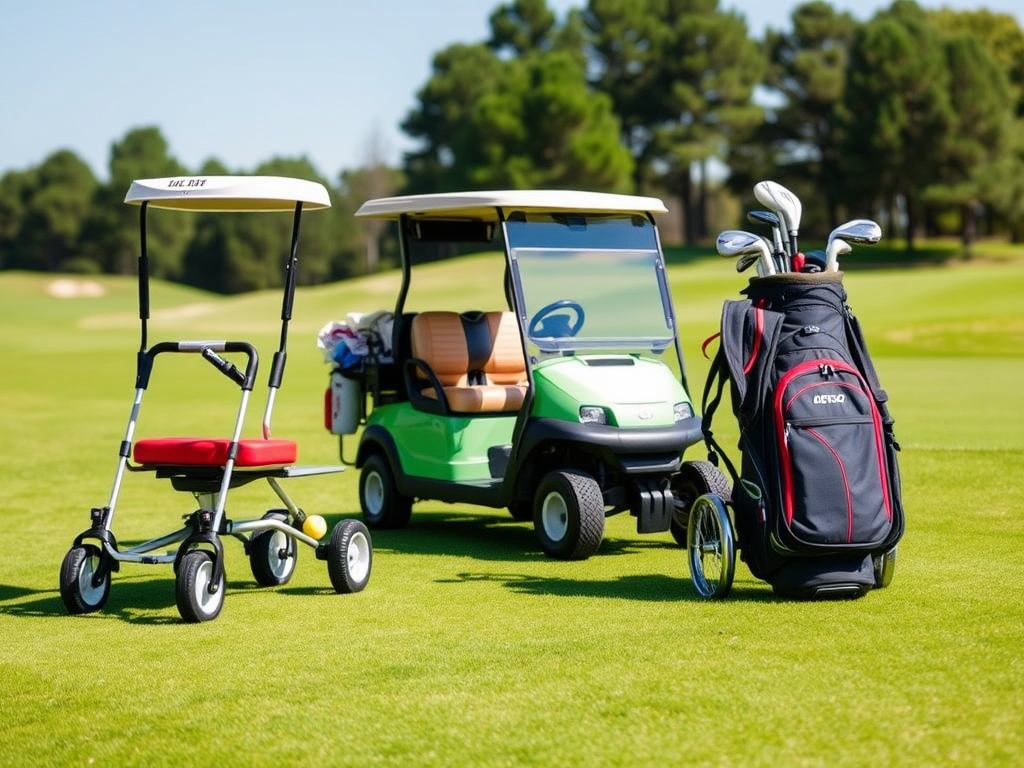
Push Cart vs Golf Cart vs Carry Bag: Honest Comparison
Push cart, riding cart, or carry bag? Real calorie data, scoring research, and cost math to help you choose how to get around the course Golf Push Cart vs Golf Cart vs Carry Bag: An Honest, Data-Backed Comparison How you move your clubs around eighteen holes is one of the few equipment decisions in golf that measurably affects three things at once: your health, your score, and your wallet. It is also one of the least examined. Most golfers default to whatever they started with — a carry bag from their beginner set, or a riding cart because that is what the course rents. The research on this is better than you would expect. Exercise physiologists have put golfers in VO2 masks and measured energy expenditure across all three modes. Golf associations have tracked scoring differences. And the results are not entirely what the marketing on either side would have you believe. This comparison covers what the studies actually found, where each option genuinely wins, the real cost math over one season and five seasons, and — importantly — the honest downsides of each. No option here is universally best, and anyone telling you otherwise is selling something. The Short Version If you… Choose Why Want maximum exercise with minimum joint strain Push cart Nearly the same calorie burn as carrying, without the shoulder and back load Play fast, carry little, walk short courses Carry bag Lightest option, no equipment to store or transport, cheapest by far Have mobility limitations, play in extreme heat, or need pace-of-play speed Riding cart Removes the physical barrier entirely; some courses mandate it Play 36 holes in a day or are recovering from injury Riding cart or electric push cart Fatigue management matters more than calorie burn over long days What the Research Actually Found The most frequently cited study on this question was conducted by the Colorado Golf Association in partnership with exercise physiologist Neil Wolkodoff. Ten golfers each played three separate nine-hole rounds — one with a push cart, one with an electric push cart, and one riding — while wearing VO2 measurement equipment. Calorie Burn by Transport Mode A separate frequently cited data set from the Rose Center for Health and Sports Sciences measured calorie expenditure across nine holes: Method Calories (9 holes) Relative to Riding Carrying your own clubs 721 +75% Push cart 718 +75% Walking with a caddie 613 +49% Riding in a motorized cart 411 baseline The finding that surprises most golfers Push cart: 718 calories. Carrying: 721 calories. That is a difference of three calories over nine holes — statistically meaningless. You get essentially the entire fitness benefit of carrying your bag while removing 15 to 30 pounds from your shoulders and back. Other framings of the same underlying research put it differently: golfers walking with a push cart burn roughly 36 percent more calories per hour than those riding, with the gap widening over a full eighteen holes. Golf Digest’s coverage of the Wolkodoff study reported walkers burning almost 80 more calories per hour than riders. A Necessary Caveat on the Numbers Published calorie figures for golf vary enormously depending on methodology. A peer-reviewed review noted estimates for activity energy expenditure ranging from 531 to 2,467 kilocalories per eighteen holes — a nearly fivefold spread — attributed largely to differences in how researchers measured it. More conservative, ecologically valid measurements from Kasper et al. reported activity energy expenditure of roughly 650 to 750 kcal per eighteen-hole round, with no significant differences between carrying, push trolley, and electric trolley. That study did not include a riding group because it was conducted during a period when cart use was not permitted. The honest summary: walking clearly burns more than riding, and push cart is essentially equivalent to carrying. The precise numbers should be treated as directional rather than exact. The Scoring Data: Does Walking Actually Help Your Game? This is where the Wolkodoff study produced its most interesting finding. Over nine holes, scores relative to par broke down as follows: Transport Mode Score Over Par (9 holes) Self-Reported Mental Focus (of 10) Push cart 10.4 Higher than riding Electric push cart 10.2 6.63 Riding cart 11.5 5.01 Walkers finished roughly 1.1 to 1.3 strokes better over nine holes than riders, and rated their mental focus meaningfully higher. Wolkodoff’s own explanation was about decision-making rhythm: walking gives you time to think about the shot, rehearse it, and arrive at the ball prepared. In a cart you are holding on, then abruptly out and hitting. Where This Finding Needs Qualification A more recent peer-reviewed study on tournament golf raised the counterpoint honestly: cognitive benefits from walking may be offset by accumulated physical fatigue over eighteen holes or in demanding conditions. Fatigue has been separately linked to reduced shot consistency. Because lower activity energy expenditure means less physical fatigue, riding may help maintain physical readiness on long or hot rounds. The researchers’ own conclusion was that further research is warranted on the trade-off between cognitive and physical fatigue across transport modes. Anyone presenting the scoring benefit of walking as settled science is overstating it — the nine-hole finding is real, but the eighteen-hole and tournament picture is genuinely more complicated. Option 1: The Carry Bag How It Works A stand bag with dual shoulder straps, typically weighing 4 to 6 pounds empty and 20 to 30 pounds fully loaded with fourteen clubs, balls, water, and accessories. Where It Genuinely Wins Cost is the obvious one — you need a bag regardless, so this option adds nothing. Speed is the second: no equipment to unfold, maneuver around bunkers, or navigate through narrow gaps. On tight, walkable municipal courses, a carrying golfer often moves faster than a push cart golfer. Storage and transport also matter more than people expect. A carry bag fits in any trunk. A push cart takes up meaningful space, and folding and unfolding it every round becomes a small tax on your time. The Honest Downsides Twenty
Push Cart vs Golf Cart vs Carry Bag: Honest Comparison Read More »