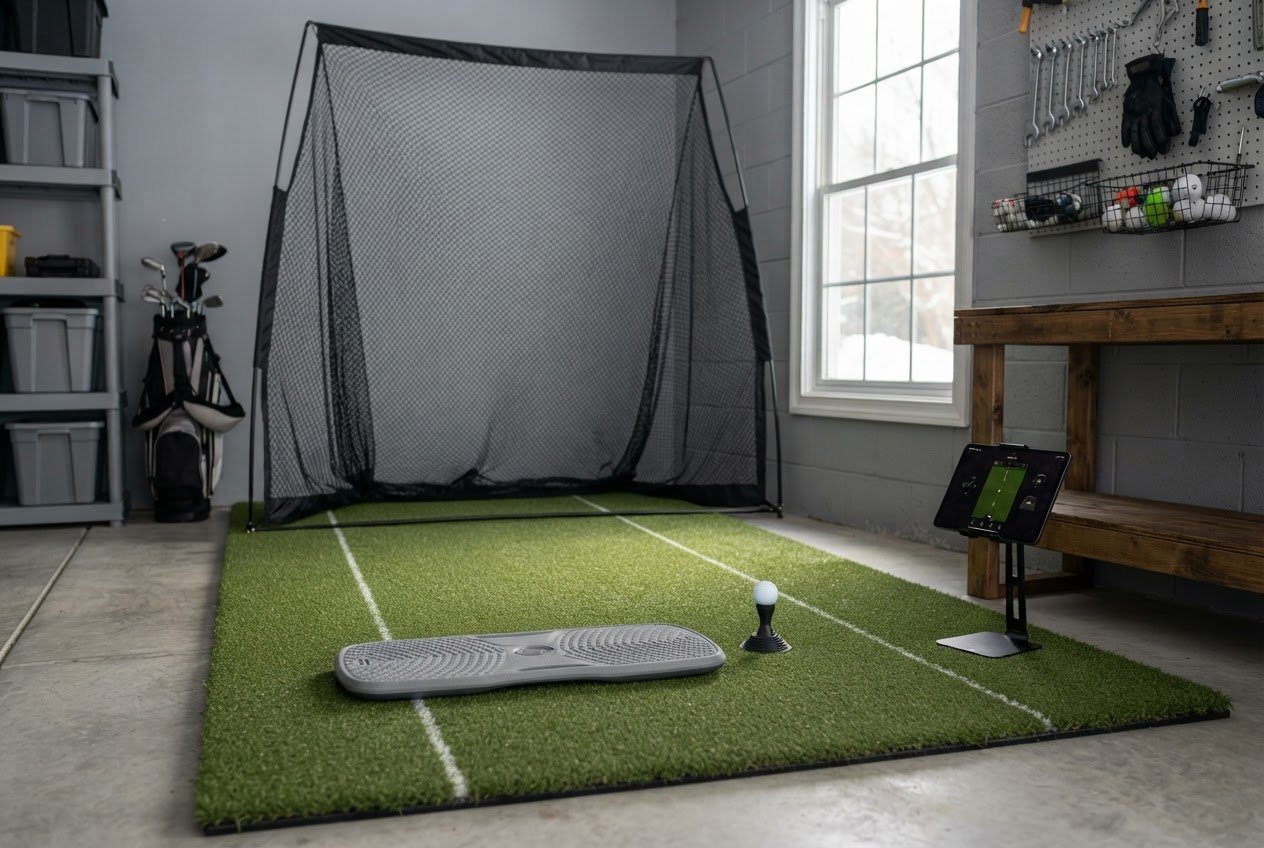
Here’s how to practice golf at home in winter: putt on a carpet or mat almost every day, chip soft foam balls into a target, rehearse your swing slowly in front of a mirror, and add two short strength and mobility sessions a week. If you have a garage or basement with about 10 feet of ceiling, a hitting net lets you make full swings too. Twenty focused minutes a day beats one long range session a month.
Picture the March version of you. The course just opened, your buddies are rusty, and you roll in your first three 4-footers like it’s July. That’s not luck. That’s a winter of 15-minute putting sessions in the hallway.
This guide shows you exactly what to practice based on the space you have, which drills actually carry over to the course, and an 8-week winter plan you can start tonight.
⛳ Quick Answer: How to Practice Golf at Home in Winter
- Putting (any room): 3- to 6-foot putts, gate drills and distance ladders, 10 to 15 minutes a day.
- Chipping (living room or garage): foam or practice balls onto a towel or into a basket.
- Full swing (no net needed): slow-motion mirror swings and pause drills.
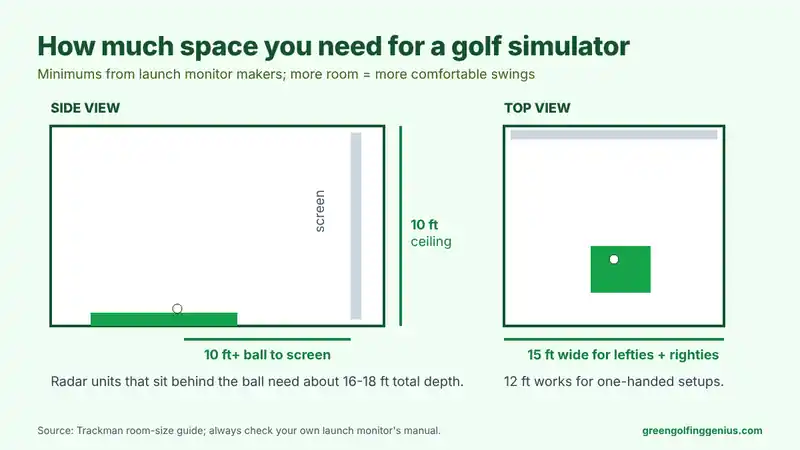
- Full swing with a net: needs roughly 10 ft of ceiling and 12 ft of width for a driver.
- Body: 2 strength and mobility sessions a week to keep your turn and speed.
In this guide
What You Can Practice in the Space You Have
Start by matching drills to your room, not the other way around. A tiny apartment can still build a great putting stroke. A two-car garage can handle full swings into a net. Here’s how it breaks down.
| Your space | What you can work on | What you’ll need |
|---|---|---|
| 🛋️ Small apartment or bedroom | Putting, grip, setup, slow-motion swing positions | Putter, a few balls, a mirror, a coin or tee |
| 🚪 Hallway or long rug | Putting distance control up to 15–20 ft | Putting mat or carpet, tape for targets |
| 🏠 Living room with clear space | Short chips with foam balls, half swings | Foam or limited-flight balls, a towel or basket |
| 🚗 Garage or basement, about 9–10 ft ceiling | Full swings into a net, wedges to driver | Hitting net, hitting mat, real balls |
| 🖥️ Dedicated room, 10 ft+ ceiling | Full swings with ball data | Net or enclosure plus a launch monitor or simulator |
Room numbers follow SkyTrak’s space guidelines. Taller golfers need more ceiling height.
How much room is enough for a full swing? SkyTrak’s indoor space guide recommends about 10 feet of ceiling, notes that many golfers find 9 feet is enough, and suggests a room about 12 feet wide and 17 feet deep for a comfortable setup.
Once you know what your room can handle, start where the strokes are: the putting green.
Putting Drills at Home (Any Room Works)
Putting is the easiest part of golf to practice indoors, and it pays off fast. Arccos data reported by Golf Monthly shows that amateurs from scratch to 20 handicap make less than 40% of putts from 6 to 9 feet. Winter is the perfect time to own that range.
1. The gate drill (start line)
Set two tees or two coins just wider than your putter head, then place a ball between them. Make strokes without clipping either “gate.” It trains a square path and centered contact. Start at 3 feet and move back to 6 once you can go 10 for 10.
2. The 3-6-9 ladder (distance control)
Put tape lines on your carpet at 3, 6 and 9 feet. Putt one ball to each line, then go back down the ladder. Your goal is to stop each ball within a putter grip’s length past the line. This builds feel, and feel is what saves you from three-putts in April.
3. The circle drill (short-putt pressure)
Place five balls in a circle 3 feet from a cup or a coin. Make all five in a row. Miss one and you start over. Then try it at 4 feet. It sounds easy until you’re on ball number five.
Think about a 15-handicapper named Dave who spends 10 minutes a night on this one drill from December to February. He’s not changing his stroke. He’s teaching himself that a 4-footer is automatic. Come spring, that’s a stroke or two a round he doesn’t give away.

Chipping and Short Game Indoors
You can’t take divots in the living room, but you can work on the two things that matter most around the green: contact and landing spot.
- Towel landing drill. Lay a hand towel 10 to 15 feet away and chip foam or practice balls so they land on it. You’re training where the ball lands, not where it stops.
- Laundry basket chip. Chip into a basket or box from 3 different distances. It forces you to control height as well as distance.
- Brush-the-mat drill. On a hitting mat, make short chipping strokes that brush the mat right where the ball sits. If you hear a thud before the ball, your low point is too early.
- One-handed chips. Hit 10 chips with your lead hand only. It quiets wristy flicks.
Use foam or limited-flight balls in any room with windows, TVs or people. A real ball chipped thin across a living room is a very expensive lesson.
Full Swing Drills With and Without a Net
Here’s the catch with indoor full swings: without ball flight, it’s easy to groove a bad move. So keep each drill tied to one specific feel or position.
No net? Try these
- Mirror setup checks. Check posture, ball position and grip in a full-length mirror for two minutes before every session.
- Slow-motion swings. Make 10 swings at about a quarter of your normal speed, pausing at the top and at impact. Slow is where real change happens.
- Pause at the top. Swing to the top, hold for one second, then swing through. It fixes rushing from the top, a common cold-weather habit.
- Towel under the arms. Tuck a small towel under both armpits and make half swings without dropping it. It keeps your arms and body working together.
Have a net? Make it count
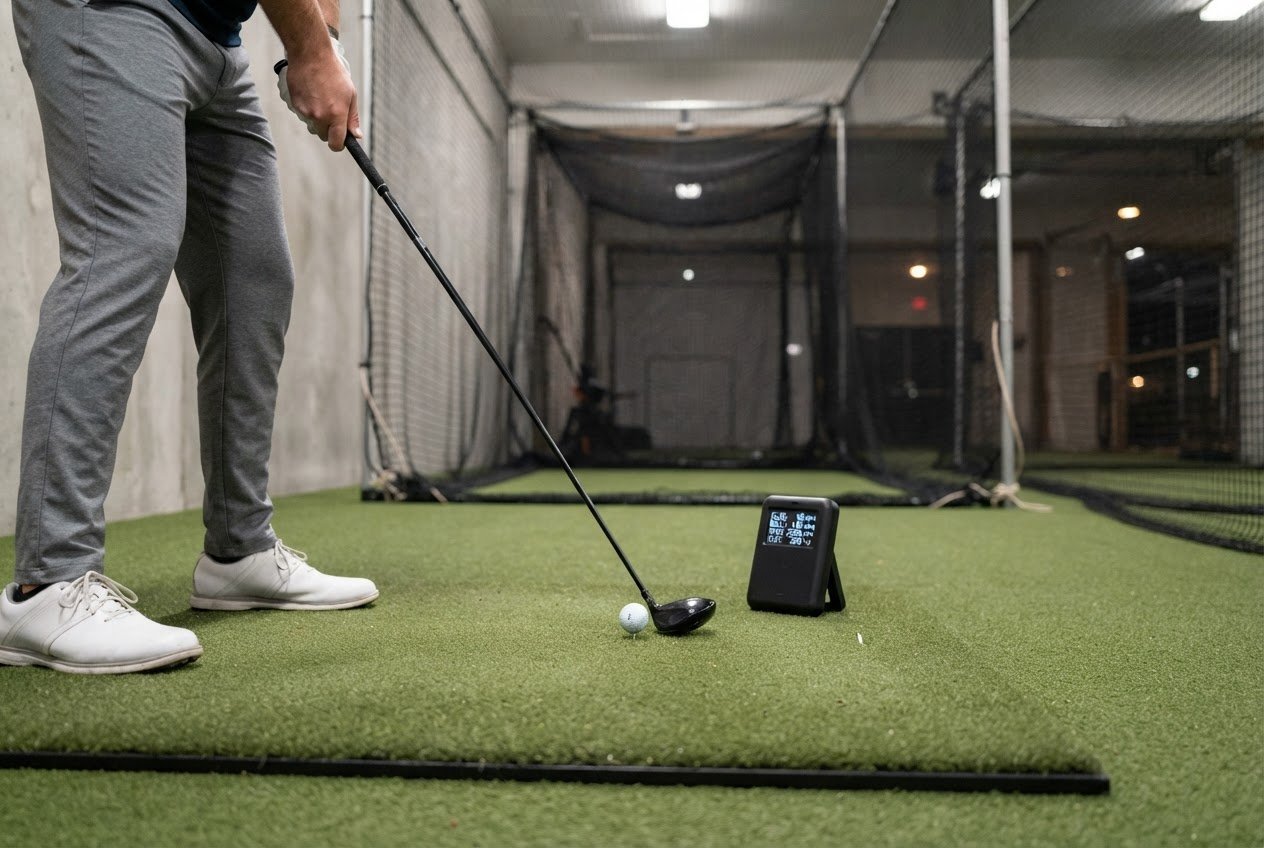
Hit with a purpose, not just to hear the thwack. Pick one target on the net, choose one swing thought, and hit in sets of five. Rest between sets. If you own a launch monitor, track one number, like strike location or club path, instead of staring at every stat.
Now that your swing work is covered, don’t skip the part most golfers ignore all winter.
Golf Fitness for Winter
The PGA of America lists a winter fitness routine as one of the top ways to improve over the off-season, along with keeping a club or putter within reach and taking indoor or virtual lessons. A stiff, weak body in March undoes a lot of good putting work.
For general health, the CDC recommends adults get 150 minutes of moderate activity a week plus muscle-strengthening on 2 or more days. For golf, focus those strength days on:
- Rotation: open-book stretches and seated trunk rotations.
- Hips: glute bridges and hip hinges, which help you turn and post up.
- Core: dead bugs and side planks, which help you keep posture.
- Grip and forearms: a squeeze ball while you watch TV.
If you’re over 60 or getting back into exercise, our guide to golf exercises for seniors has a gentler weekly plan. And always warm up before swinging in a cold garage. Our golf warm-up routine works indoors too.
8-Week Winter Practice Plan
Here’s a simple plan that fits around a work week. Each session is 20 to 30 minutes. Do four sessions a week and keep a little notebook of your scores on each drill.
| Weeks | Main focus | Mon | Wed | Fri | Sat or Sun |
|---|---|---|---|---|---|
| 1–2 | Setup and start line | Mirror checks + gate drill | Strength day | Gate drill + circle drill at 3 ft | Slow-motion swings + strength |
| 3–4 | Distance control | 3-6-9 ladder | Strength day | Towel landing chips | Pause drill swings or net sets |
| 5–6 | Contact | Brush-the-mat chips | Strength day | Circle drill at 4 ft | Towel-under-arms swings or net sets |
| 7–8 | Pressure and test | Circle drill, start over on a miss | Strength day | Ladder test: score out of 10 | Full routine + course-day warm-up |
Keep putting on most days, even for 5 minutes. It’s the skill that fades fastest when you stop.
Want a simple benchmark? In week 1 and week 8, count how many 4-foot putts you make out of 20. Write both numbers down. Seeing that jump is what keeps you going in February.
Gear by Budget
You don’t need a simulator to get better this winter. Here’s how the options stack up.
| Level | What to get | Best for | Skip if |
|---|---|---|---|
| 🆓 Free | Putter, balls, tees, coins, tape, a towel, a mirror | Putting and swing positions | Never. Everyone should start here |
| 💵 Low cost | Putting mat, foam or limited-flight balls, alignment sticks | Daily putting and soft chipping | You already have a long, flat carpet |
| 💰 Mid range | Hitting net and a good hitting mat | Full swings in a garage or basement | Your ceiling is under about 9 ft |
| 🏆 Big investment | Launch monitor or full home simulator | Players who want ball data all winter | You won’t use it at least weekly |
If you’re weighing the top tier, our breakdown of how much a golf simulator costs shows real prices for five home builds, part by part.

Mistakes to Avoid
- Hitting real balls in a room that isn’t built for it. Use foam balls unless you have a proper net and space.
- Practicing without a target. Every drill needs a goal you can score.
- Only hitting driver into the net. It’s fun, but your scores live inside 100 yards.
- Cranking full speed in a cold garage. Warm up for 5 minutes first.
- Changing everything at once. Pick one swing fix for the whole winter.
- Skipping putting because it’s boring. It’s the easiest place to save strokes.
- Stopping cold in December and starting again in April. Short, regular sessions beat rare long ones.
Frequently Asked Questions
Can you really improve your golf game at home in winter?
Yes. Putting, chipping contact, setup and swing positions all improve with home practice. Short daily sessions of 15 to 30 minutes, plus some strength and mobility work, can have you sharper in spring than you were in the fall.
How much ceiling height do I need to swing a golf club indoors?
SkyTrak recommends about 10 feet for full swings, and many golfers find 9 feet is enough. Taller players and longer clubs need more. Always test with slow-motion swings before hitting balls.
What is the best golf practice at home without a simulator?
Putting drills like the gate drill and 3-6-9 ladder, chipping foam balls onto a towel, mirror setup checks, and slow-motion swings with pauses. A hitting net and mat add full swings if you have the space.
How often should I practice golf at home in winter?
Aim for 4 sessions of 20 to 30 minutes a week, with a few minutes of putting on most days. Consistency matters more than long sessions.
Is a putting mat worth it for winter practice?
For most golfers, yes. A mat gives you a true, flat surface and a target, which makes daily putting easier. A long, smooth carpet can work too if you don’t want to buy one.
The Bottom Line
Winter doesn’t have to mean starting over every spring. Putt a little almost every day, chip soft balls at a target, rehearse your swing slowly, and keep your body strong. Follow the 8-week plan, track your 4-footers, and you’ll show up to the first warm round of the year with a game that’s ready, not rusty.
Keep learning: more guides from Green Golfing Genius
- How much does a golf simulator cost? 2026 prices by budget
- Golf warm-up routine: 5, 10 and 15-minute plans
- Golf statistics every amateur should know
- Gifts for golfers who have everything
Sources: SkyTrak indoor space guide; Golf Monthly reporting on Arccos putting data; PGA of America; U.S. Centers for Disease Control and Prevention. Updated November 2026.
What’s your go-to winter drill? Share it in the comments.